Tuesday, 12 November 2013

Mitch Epstein: American Power

As my project focuses heavily on the observation of the energy industry but with a critical eye, it makes complete sense to look at somebody who has done it all already; Mitch Epstein. In his project aptly named American Power, he has essentially gone around as some sort of energy sightseer, touring America to find each power station facility far and wide in all their glory nakedness. He spent 5 years conducting his exposition of these places to help give clarity to their connected purposes, be it strengths, weaknesses or in some cases abandonment. It's worth bearing in mind, this project took place in the post-9/11 Bush era where everybody was on their toes about security and any endangering activity. According to The Guardian, he was regularly stopped, searched, followed, and even run out of town. (http://www.theguardian.com/environment/2009/oct/03/mitch-epstein-power-plants-photographs)
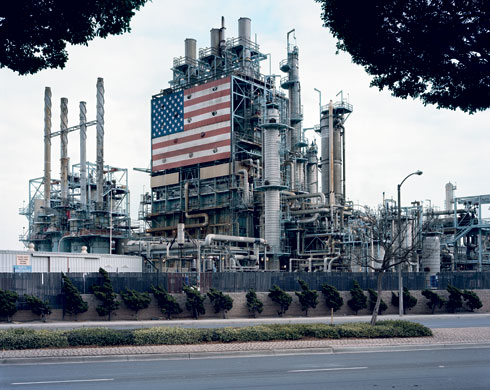


In the above image, you can see BP Carson Refinery in California. He took this in 2007, and published it in 2009 with Black River Productions. The aesthetic complexity of the facility provides a somewhat pleasing experience for onlookers, and the exposure Epstein has captured provides a warm yet somewhat overcast image of the place. In the image, the mechanical architecture is visually boxed in by the nature that surrounds it, almost a metaphor for the threatening ability that comes as an implication towards what these facilities are capable of doing to nature as a whole. These simple landscapes combine as something more, they have a certain silent comment attached about political and corporate power, which provides Epstein with freedom and ability to show the world what these places truly behold when they are seen bare from the public view. John Vidal says in a separate Guardian article "Epstein photographed coal mines, solar arrays, oilfields, half-empty dams, smokestacks, fuel cells, nuclear plants and pipelines, but also many of the things the most energy-profligate nation on earth does with all that power – such as build Las Vegas and golf courses in the desert, send tanks to Iraq, blow the tops off mountains to find coal, make nuclear bombs and electric chairs." All these photographs can be caption-free and still make a difference to viewers when the images are presented as one.
(http://www.theguardian.com/environment/2009/oct/03/mitch-epstein-power-plants-photographs)
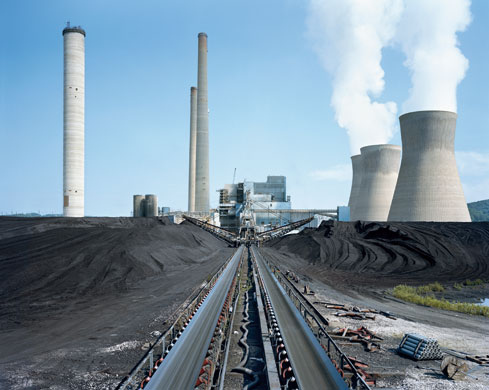


This image is taken of Amos coal power plant, in Winfield, West Virginia, 2007. The Guardian claims that his pictures, he says, show the 'beauty and terror of early 21st-century America as it clings to past comforts and gropes for a more sensible future', a future with no current direction. This very tedious and exasperated method of energy creation has served its time for many decades, but the method has had little implication of bettering the world long-term whilst it does its job.
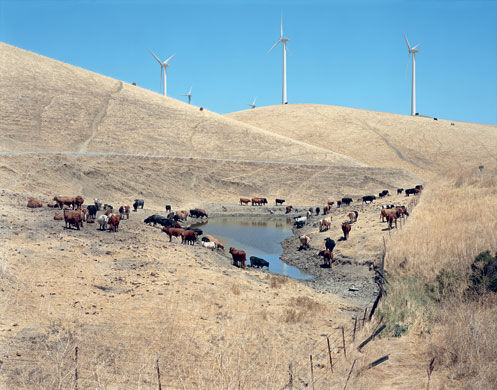


This image particular sticks out as a subtle way of showing where technology and nature blend in together fairly seamlessly. There is an argument to be had here as to whether this successfully merges the two or creates an imbalance of binary opposites. Taken in Altamont Pass wind farm, California, we can see the Wind Farm sits among nature with little more than a wave of some kind of blade placed out of harms way. With an exception to birds, this method does nothing to interrupt the nature surrounding it, aside from a visual disturbance for humans. Those who choose to complain about such facilities should reflect on the fact that there are truly worse things that could be seen, such as a very large chimney outputting harmful gas.


In this instance, my point is a little more obvious - this truly separates the foreground from the background. This image also shows Amos coal power plant, Raymond City, West ­Virginia, taken in 2004. The presence of greenery; trees and grass amongst the quaint little houses, all of it is interrupt by the gargantuan chimneys cascading in the background as towers. Aside from those who appreciate architecture, most people would believe this to be the true distraction, visually. Epstein has created a whole set of brilliantly captured photographs, with great composition, binary opposition, and comment. He will greatly influence my photography for this project.

Thursday, 7 November 2013

A Look At Hydraulic Fracturing

Hydraulic Fracturing, which is also commonly referred to as Fracking, is the new kid on the block for energy creation. The name lends itself to the process of fracturing the rock deep under ground - this method is used in multiple ways for extraction purposes. The most common material being to release shale gas, tight oil, or any other valuable limited supply locked away in rocks that were previously unreachable. The water is usually mixed with sand or grit to help grind away at the available cracks hidden deep within the ground, these are known as fissures. These fissures can be as little as 1mm across before the grit gets to them, the grit then helps keep the fissures open for the extraction of sources that are deemed useful. The drill is usually sent downwards, then after a period of time, it's sent horizontal for miles at a time so that the whole rocky layer is exasperated of it's locked away resources.


The whole 'Fracking' process has come under a lot of fire with environmentalists as the sites where it takes place require transport of water in very large amounts, at a cost to the surrounding area. The process of which a drill has to gouge out huge holes within the rocks is a permanent thing, once the drilling is complete, that natural rock will always show gaping wells within the ground, and only for a limited benefit. The implications of destroying something permanently for a short fix (in the grand scheme of things) is a concern of many organisations, including Friends of the Earth. One spokesperson on behalf of this organisation, spoke for the BBC; "Shale gas is not the solution to the UK's energy challenges," said Tony Bosworth, Friends of the Earth energy campaigner. "We need a 21st century energy revolution based on efficiency and renewables, not more fossil fuels that will add to climate change."

Hydraulic Fracturing is just another way to avoid creating a modern energy solution for the growing problem of climate change, in a world with a limited number of years remaining before our worldly habitat becomes ever more dangerous for general living, and the resources we use are depleted to the point at which we would need to find another solution anyway. Fracking is only a diversion from the true problem that we face as a generation of people that need electricity for almost everything that we do, even the most mundane of tasks.


Monday, 4 November 2013

Temple of Power


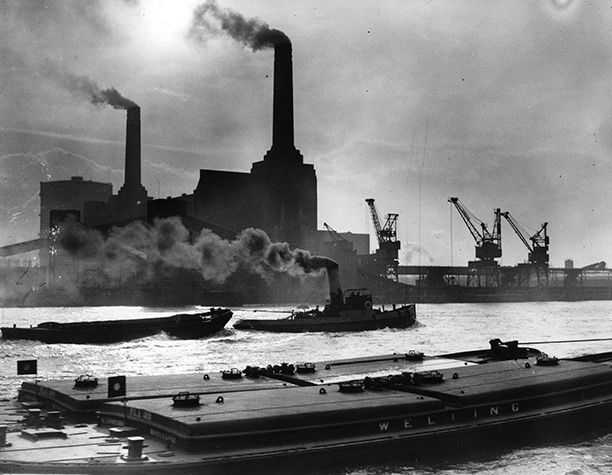
The Temple of Power describes an energy facility that existed in 1940, but has since been decommissioned. Battersea Power Station, as it is formally known, actually only had 2 chimneys until around 1950, when the extra two were added. Needless to say, it was decommissioned within 1983, due to it's machinery wearing itself out, and the drifting of Coal as the industry leader for electricity creation. It was in 1980 that the boiler house roof was removed to help aid the process of removing a lot of the machinery.

The chimney's CO2 emissions can be seen lifting skywards as the industry's heavy reliance upon Coal had aided us in creating the next-generation of technology. Coal is still a fuel we choose to aid us in our creation, but as the environmental concerns creeped in, we have shifted a little ways towards wind-generated power sources, wave breaks, and some places choose to incorporate solar power - although this usually happens on a company by company basis. This monumental building truly showed us what capability we have in the coal industry, but also the potential destruction it can cause to our environment. The output of Carbon Dioxide into the atmosphere is slowly warming the planet, the very fact that this building isn't operational anymore is an initial step towards achieving a coal-free environment.


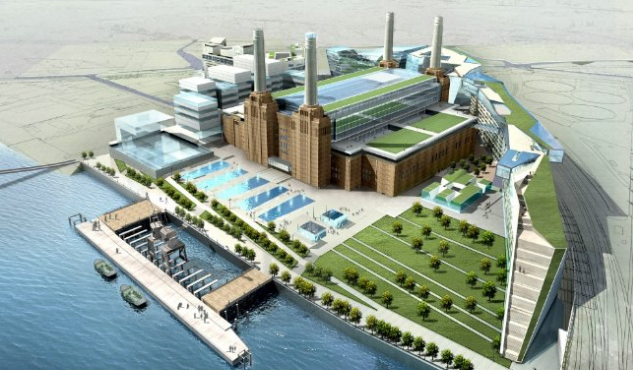
The remains of the building are now being renovated to create blocks of flats around it, and a shopping centre within the main building of Battersea Power Station. As you can see above, the building has already got mock-ups of its potential visual. The reuse of such a wonderful artefact will prolong its relevance within modern society, whilst also maintaining a hint towards its heroic past as a power house for energy creation. One step closer to a coal-free environment, one step closer to reducing CO2.


Saturday, 26 October 2013

Edgar Martins: The Time Machine

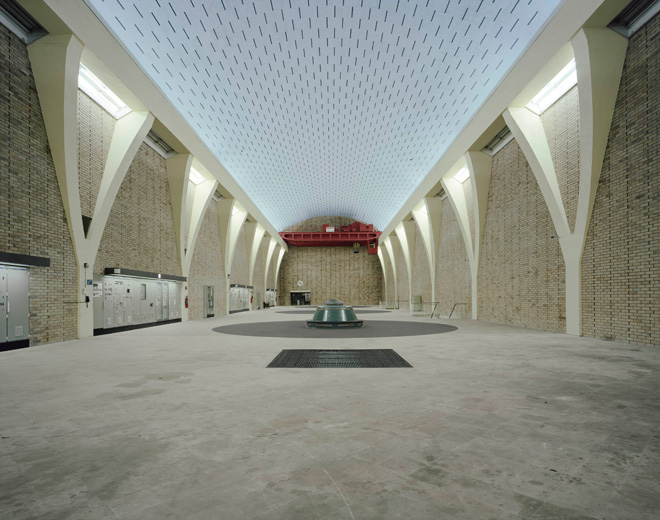
In 2010, Edgar Martins was granted access to around 20 power stations facilities within Portugal so that he may photograph the interior and show the world. Many of those facilities were actually built between 1950 and 1970, "a time of hopeful prospects for rapid economic growth and social change" according to dissfussionfestival.org. They go on to speak of his work as a way of documenting a period in time of which the facilities' design was intentionally progressive as a way to testify to the scope and ambition of the original vision they were built to serve. 
(http://www.diffusionfestival.org/programme-item/the-time-machine/)

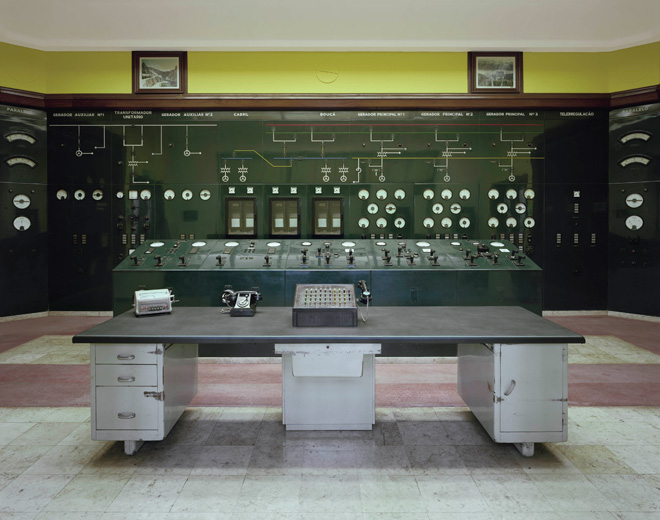
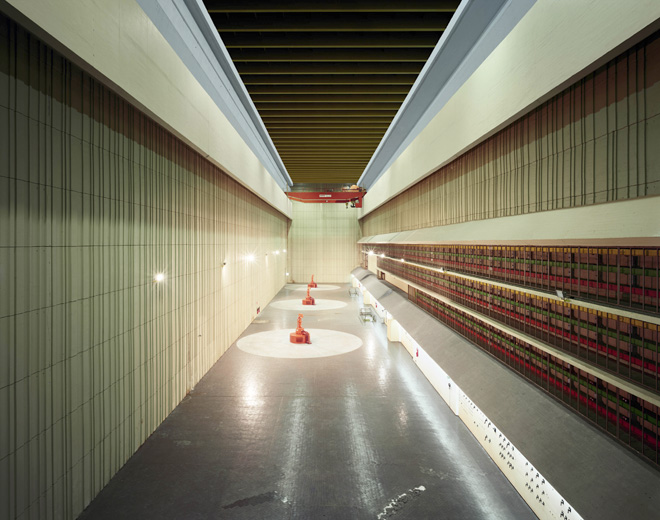
This work brings a sense of nostalgia to the industrial designs well known from 1970s science-fiction films and TV shows. The work, almost dated in itself, brings a sense of attempted harmony, but with a hint of neglect as the photo presents itself in isolation from any human operation.


As you can see above, the control room is readily available for use and operation, yet the contact and human interaction is almost nonexistent. The surfaces are clear, pristine, almost untouched. The centralised subject shows a cohesive look at the overall symmetry within the room, yet the cleanliness almost lends itself to being a novelty than a tool. The flooring shows it withheld the weight of many feet, and the steps have almost taken their toll whilst the tools show a binary opposite. This eerily opposing imagery is both aesthetically pleasing, and saddening. 


It's saddening to see that such a grand facility would be abandoned, the opportunities it has left behind, laying in the dust of the previous human presence. The ever-evolving has chosen against keeping this wonderful place from creating electricity for us. I think it's worth noting that all of these facilities are hydro-electricity power plants. Now, as a society, I believe we've not properly looked at the most opportunistic options for energy creation, and we aren't much further in finding a sustainable reliable source that can provide energy for us at a substantial rate. Hydro-electricity was a safe option for humans as the proximity of the water itself was no issue whatsoever, unlike the other nuclear options that many are exploring today. It isn't a criticism, it's more a reflection of my own opinion that as a world we haven't entirely found a solution that presents itself as safe that has great potential. 


The real beauty of Edgar Martins' "The Time Machine" is the symmetry, perfect dimensions, and overall order within his set of images that ominously sets it apart from the contrasting messiness that is human nature, and yet we created it. The centralisation of much of the imagery is visually pleasing, and is a great send-off for a place that served well, but didn't use up its time. The retrograde colouring is a tribute to a design era that we should be proud of. You can find the whole set of 64 photographs here on his website. (http://www.edgarmartins.com/work/the-time-machine-an-incomplete-semi-objective-survey-of-hydropower-stations-2011/)


Wednesday, 23 October 2013

Sparks of Interest

When I was figuring out what I wanted to write about, photograph, have an opinion on, I felt stumped right at the beginning of the year, I had no idea what I was going to look at for my Final Major Project. I was soon given a mini project task of finding an image that would be seen on the front of a newspaper, often because something special was to be happening with it. I thought it would be worth noting that my Major Project idea was sparked off of this miniature project where I had photographed the Battersea Power Station in all its remaining glory. 


I took this photo as a task which didn't present itself with a specific message needed, but more as an image that you may find in the newspaper for whatever reason. I wasn't aware however, that Battersea was under renovation to be created into a large complex of flats and shops, and this image certainly lent itself as something that may suggest this beautiful building was to becomes something more. I was also told of how this image was aesthetically pleasing, but didn't immediately suggest that it was related to energy. This sparked my interest to start looking into observing where modern society is with energy. 

Sunday, 20 October 2013

The Facts and Politics of Non-renewables

The difficult position we have put ourselves in as a modern society is not to be taken lightly. Currently, the world is usurping resources that are not renewable, these are often referred to as Non-renewable energy. This consists of Fossil fuels and Radioactive fuels. Fossil fuels include Petroleum (crude oil) which is split up into several densities and types, Coal, which is the largest source of energy, and natural gas, which is fairly self-explanatory, originating from places where the creation of the gas excludes a man-made process.

These natural resources are of limited supply, a limited supply within our world, and the outcome of using these fuels as energy is wasteful and isn't ideal as a solution to our energy needs. Radioactive fuels are the other side of the coin, a same limited supply material, but completely different in context. Uranium is the material used, and has no other applicability, aside from being dangerous for humans in near contact. This makes it slightly more appealing as a fuel, since it is naturally harmful for our race. This creates the basis for a slightly more trustworthy fuel, despite it's non-renewable status. Many companies take advantage of uranium in nuclear power stations, but since there are dangers within the process and the waste product must be contained or disposed of in a correct manner, we are safer with coal, petroleum, and natural gases.


Petroleum, the finite resource used within many modern cars, is the substance behind many political debates. We rely heavily on oil companies to give us the fuel we need for our cars that take us everywhere, since walking isn't always an option, and driving is the easiest way to travel a great distance in a short amount of time. We have millions of cars in use, many of which are old, some people are still driving cars that are 20 years old and still serve as a tool to get from A to B. Unfortunately, the older models are expectedly worse for their emissions. Oilprice.com has a written piece surrounding the affects at which these oil companies do not wish to see their profits removed or change. In an article written late 2012, they are quoted saying:

"U.S. Rep. John Boehner, speaker of the House of Representatives, received nearly twice as much financial support from donors tied to the energy sector than did the next-closest recipient, a report from the National Wildlife Federation finds. The 20-page report highlights the role it says oil companies play in U.S. politics, stating energy companies are working behind the scenes on Capitol Hill to influence legislation in favour of oil, natural gas and coal policies. The NWF report finds that the current 112th U.S. Congress has voted one out of every five times against legislation drafted in favour of environmental issues."
[Taken from http://oilprice.com/Energy/Crude-Oil/Big-Oil-Funding-U.S.-Politics.html]

This shocking behaviour comes as no surprise to those within the political arena, those parties that battle it out within the American's Congress just to prolong the issues that are inevitably present - not just for American companies, but also worldwide. I wish to explore these political and environmental issues, not necessarily with the intention of being uniquely different in my approach, but to help rally up support for the warped wrongdoing of the companies producing the energy we all use, and the implications of their ignorance.

Monday, 14 October 2013

An Objective Look At Energy

Within my final major project, I will be expected to draw upon the skills and knowledge that I have developed over the past few years whilst being at UCA. I choose to look at something with real world value, a subject of great importance and significance to current society. My initial plan would be to look at the subject of Energy. It's purpose is intrinsic to every modern day activity, within electronic devices, cars, and major corporations. More specifically, I choose to focus on the issues surrounding energy creation, and the numerous ways in which it can be harvested.

For starters, coal has always been a standard fuel in which we burn to transform into the electricity we know, love, and depend on. This fuel is of limited supply, as is that of natural gases. Thus, we have chosen nuclear as an option too, which unfortunately is a dangerous subject to go down, and the current method produces a large amount of waste, only 1% of the product used for nuclear is actually usable in today's current methods.

CO2 is the gas we output most of in the world, as it serves to be fairly safe for human breathing as it's the same gas we exhale. But as the appetite of the world increases exponentially by the year, one has to question the use of non-renewable sources for our energy, and the destruction it may be causing in the long-term. I plan on delving deeper into this subject to find out just how this affects us, if and how it may affect the current generation's future.